
plf:: library and this page Copyright (c) 2026, Matthew Bentley.
Last updated 23-5-2026
Running clang-cl 19 (under MSVC 2026 x64) as compiler. Relevant build settings are standard unaltered release settings: "/GS /W3 /Gy /Zi /O2 /fp:precise /D "NDEBUG" /WX- /Gd /Oi /MD /std:c++20 /EHsc".
Full spreadsheet data is here.
For more general details and benchmark code see main page.
Click images or hover over to see results at linear scale instead


Click images or hover over to see results at linear scale instead


Click images or hover over to see results at linear scale instead


To summarize, for double on average hive is 40% slower for insert, 18% slower for erase and 5% slower for iteration.
For small structs it's 55% slower, 26% slower and 1% faster.
For large structs it's 42% faster, 18% slower and 28% faster.
Datatype is small struct (48 bytes), frame = one iteration pass over all elements in container.
Click images or hover over to see results at linear scale instead


plf::hive is 8% faster than hub on average.
Same as the previous test but here we erase/insert 1% of all elements per-frame instead of per 3600 frames, then once again increase the percentage to 5% then 10% per-frame. This simulates the use-case of continuously-changing data, for example video game bullets, decals, quadtree/octree nodes, cellular/atomic simulation or weather simulation.
Click images or hover over to see results at linear scale instead


plf::hive is 20% slower than hub on average for the 1% scenario, 22% slower for the 5% scenario, and 26% slower for the 10% scenario.
This test utilizes four instances of the same container type, each containing different element types:
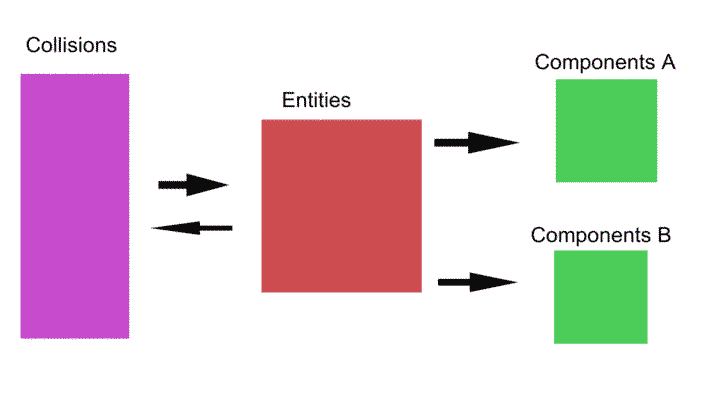
For full explanation see the main colony benchmarks page.
Click images or hover over to see results at linear scale instead


Average speed increase of hive over hub is between 22% and 408%, depending on insert/erase-to-iterate ratio, but with a massive skew in the larger numbers of elements. Up to 29x faster at highest ratio and number of elements.


Hub is generally faster except for large types and lower ratios of insert/erase-to-iteration. Where get_iterator is involved hub is much slower.
Contact:
plf:: library and this page Copyright (c) 2026, Matthew Bentley.